


It was a sunny day in the small town of Lakota, North Dakota (population somewhere between 681 and 784) and Mr. Los Angeles, his sister and I were there to lay my mother-in-law’s ashes to rest in the local cemetery.
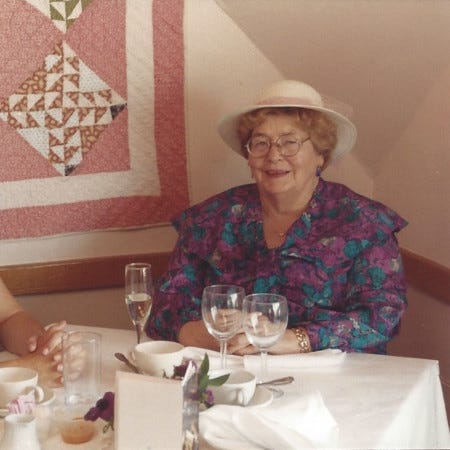
Photo by Owen Bjørnstad
The leadup to the trip had already been strange. The Dowager Mrs. Los Angeles, of whom I was extremely fond, had suffered a long and difficult deathbed, which had finally ended the previous January, when the icy North Dakota ground is too hard even to think of digging graves; when it at last came time to return her to her family plot, we had discovered that it is illegal in America to carry personal cremains on a plane, and it had become my task to send the ashes to the mortuary by the unlikely means of the parcel post. “What’s in this parcel?” the woman at the UPS had asked. “My mother-in-law,” I had replied and, because the situation was so bizarre, we had both found ourselves sobbing with laughter. When I got home, I had sobbed again, this time with grief.
Now, Agnes Olson Los Angeles was safely in the ground, having been blessed on her way by a Lutheran pastor who could not have been kinder or more gentle, and it turned out that the weekend when we were in Lakota was that of the annual turkey barbecue, the day when the entire town descends on City Park to feast on spit-roast turkeys, barbecued corn, and other delights.
Well, this was perfect timing, I thought. Agnes had talked so often and so fondly of her home town, and here her former neighbors would be out in force and available to talk to. What stories we could tell them of Agnes in her Los Angeles days, I thought, what memories of her youth we could coax them to share in return.
As soon as I had swallowed my own meal, I approached a table of folk of a likely-looking age.
“What a pretty town you have,” I said. “I’m traveling from Los Angeles and I think it’s beautiful.”
They stopped eating and looked up at me with brows furrowed in mild puzzlement.
“I’ve come with my husband and sister-in-law to bury their mother, Agnes Olson,” I explained. “She grew up here, then married Gerry from the farm, and they left for California around 1941.”
They continued to observe me thoughtfully, as one studies an exhibit of uncertain purpose in a museum specializing in primitive farming implements.
“Yah?” said one of the more gregarious after a moment.
“We’ve driven past the house she grew up in, and it doesn’t seem to have changed much,” I offered.
“Yah,” agreed Ms. Conviviality, her expression deepening from perplexity to outright bewilderment.
This was not going as I had expected.
“She went to the local high school,” I attempted. “And so did Gerry.”
“Yah,” confirmed Ms. Conviviality, shooting at her companions a sidelong glance of befuddlement.
“Do you,” I floundered desperately “… do you … remember … either of them?”
There was a pause as they all eyed each other in mutual mystification.
“Yah,” corroborated Ms. Conviviality, then. The others continued to study me for a while, and then, slowly, returned to their meal.
Broken, I trailed back to Mr. Los Angeles and his sister to describe the encounter to them.
“Welcome to the Midwest,” they said.
Back in Europe they didn’t really tell us about Midwesterners. The Americans we saw on the screen there were excitable and emotional: they were either speaking lines that had been scripted for them in movies or appearing on television talk shows to promote the movie they were appearing in – they were upbeat and enthusiastic and we used to laugh at them for describing everything and everyone as “wunnerful.” When I arrived in Los Angeles, I found to my delight that Angelenos really are like that anyway, and so – although they tend to use longer words – are New Yorkers. I had grown to think of Americans as people who wore their hearts on their sleeves.
Not in the Midwest, they aren’t. Midwesterners, I was to learn when at last I visited, guard their words and their emotions with the jealousy of a mother her newborn child. They live hard lives out in the Midwest, lives of blizzards in winter and tornadoes in summer, of farming accidents and failures of crops, and mile upon mile of prairie separating one town from another: they eat plain food and wear plain clothes, and if they yearn for some experience so inessential as attending a play or a concert, they must drive, sometimes for half a day, into the nearest city to do so. Midwesterners are good and honorable people; but they simply do not have the energy to squander on fripperies, either practical or – as I discovered at the turkey barbecue – conversational.
When I had met Mr. Los Angeles, he had told me, proudly, that his family were Midwesterners. What he had not made plain was that his family were the sort of Midwesterners who had … well … left the Midwest. Who had sat down one day in Lakota, North Dakota, where the ground is stubborn and the crops are unpredictable and the temperature dances at freezing point or below for five months out of the twelve, had figured out that there is a different place to live right here on this very globe where life is easier, and had taken themselves off to live there.
It was true that when they had arrived in Los Angeles, they had brought with them many of their Midwestern ways. They were thrifty and unpretentious and would none of them, man or woman, consider leaving the house without a full set of household tools in case of emergencies: Mr. Los Angeles still talks with pride of our first trip to London, where our hosts’ teenaged son had broken a wooden curtain rail high up in their tall Georgian house on a quiet Saturday night, which Mr. Los Angeles was swiftly able to whip out the pair of vice grips which he had packed in his luggage in order to repair on the spot. “Fixed it!” he boomed triumphantly to the fascinated circle of witnesses who had gathered, bemused, to watch. To this day, he thinks that this story reflects abnormality on them, not on him.
The family were also fiercely Lutheran in faith, and, although the Dowager stepped gallantly to the plate to accept my own slippery Papist background (truth to tell, I suspect that by the time I entered her wayward son’s domestic life, my lack of an extra head alone would have had her turning cartwheels to seal the deal), her real feelings would out themselves sometimes nevertheless. “I never thought I’d see my son married there,” she whispered faintly when we announced we were to be married at the Sacred Heart chapel of Loyola Marymount Jesuit University. I once took her to visit a Catholic artist friend who specialized in religious art: the Dowager tiptoed past the paintings of St. Francis of Assisi and St. Catherine of Siena with ever-widening eyes of panic and ever-ashening complexion of alarm; when she at last reached that apogee of Rome-driven monstrosity the Virgin Mary her own immaculately conceived self, she was overcome and retired discreetly to the bathroom, where she found immediate relief to discover the walls decorated in the impeccably respectable Old Testament theme of Noah’s Ark: she positively skipped out, rosy-cheeked and smiling, and the two women were firm friends from then on.
Practicality, Lutheranism, and please let’s tiptoe quietly past my father-in-law’s beloved Ole and Lena jokes, and all, you would never now confuse the Midwestern Los Angeles family I married into with the Midwesterners who have stayed there. Whether California has changed the Los Angeles family or whether it was personal qualities of their own that drew them to California, I couldn’t say; but certainly, after nearly a century of living in the Los Angeles sunshine, they are one hundred and eighty degrees different from the North Dakotans they left behind: they are lighter in bearing, sunnier in outlook, more open in manner; they tell stories – oh, how the Los Angeles family loves to tell stories – they even make jokes.
It turns out that even their vocabulary has changed. We once had a visit from a young Norwegian relative, a charming, if earnest, young man with his nation’s stick-straight blond hair, with whom we spent an immensely pleasurable first afternoon talking family, Norway, and, inevitably in the Los Angeles family, household tools.
“That was delightful,” said the Dowager to him as the occasion ended. “Well, I guess we’ll see you mañana.”
The youth blinked in confusion. “But I thought we were meeting tomorrow,” he said.
As confused as he, the Dowager blinked back. “That’s what I said,” she said. “Mañana.”
It seemed the staunch little Lutheran lady had not realized to what an extent the language of the dreaded Los Angeles Catholics had infiltrated her own.
Oh Gabrielle! There’s the basis of a wonderful book here.
Lovely memory