


“I need help,” I not very controversially informed the young man who answered the telephone at the company’s Help Desk. “I’m trying to fill out the application form, but I’m on Page 2, I’ve just realized I made a mistake on Page 1, and I can’t figure out how to go back to Page 1 and fix it.”
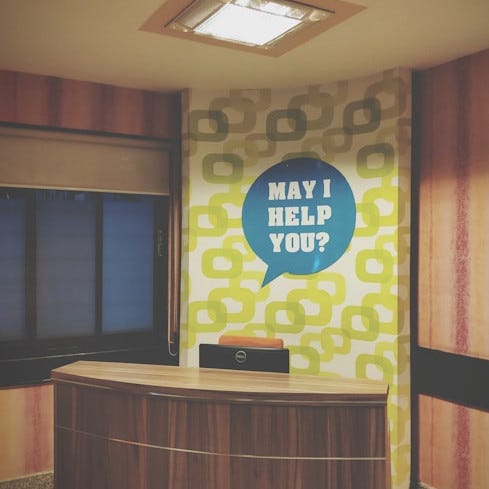
Photo by Gaurav Dhwaj Khadka on Unsplash
Had I been a different person, I would not have needed to call the Help Desk for this, because I could have applied to Mr. Los Angeles instead. Mr. Los Angeles happens to be a professional computer guru, able to fix the most intransigent of computer malfunctions with just one stab of his preternaturally skilled keyboard finger. There is in Los Angeles a not insubstantial community of friends, and neighbors, and friends of neighbors, and neighbors of friends, who have in their homes small shrines to Mr. Los Angeles and his computer genius. However, I am not a different person, I am Mr. Los Angeles’ wife; and as anyone married to a computer guru knows full well, seeking help from their computer guru spouse is more or less tantamount to putting their divorce lawyer on speed dial.
“Not a problem,” said the young man. “It’s very simple, in fact. You just click on the binky, then drag down the trinky, and then choose glinky.”
The level of ignorance of Mr. Los Angeles’ wife where technology is concerned is verging on the monumental: I am the reverse of proud of this, but on the whole find it more productive to acknowledge it than to try to hide it.
“I don’t understand what you just said,” I said.
So he repeated it, more slowly.
“I said,” he said. “You click on the binky. And then you drag down the trinky. And after you’ve done that, you choose glinky.”
“I know you said that,” I said. “I did hear you say it. But the problem is, I don’t know what any of those three words means.”
The young man refrained from sighing: he was a polite young man.
“OK,” he said. “We’ll take it from the top, shall we? First you click on the binky. Then after you’ve done that, you drag down the trinky. And after you’ve gone to the trinky, you scroll past the zinky and choose glinky.”
“You said that last time,” I said. “And I would be delighted to use a binky or a trinky or even an iwantadrinky if I had the faintest idea what they were. But, as I have explained to you, I don’t.”
The young man still did not sigh; but he did take a deep breath. Across the telephone line I could hear him begin to wish he had not given up smoking the week before.
“We can do this,” he said. “We’ll work through it together. You’re sitting in front of your computer, right?”
Since I, too, attempt to exhibit politeness, I refrained from pointing out that there would be not a great deal of point in our having this conversation if I were not.
“Right,” I said.
“Right,” he said. “And you have your form open in front of you, right?”
I further restrained myself from observing that the precise reason why I had called him was to seek help with navigating that same form.
“Right,” I said.
“And you’re looking at Page 1,” he said. “Right?”
“Wrong,” I said. “I’m looking at Page 2. As I told you, Page 1 is where I want to be, but I’m calling you because I can’t figure out how to get back there.”
“Right,” he said. “Now we’re getting somewhere, right? You’re not on Page 1, you’re on Page 2, right?”
“Right,” I said.
“Right,” he said. “This is good to know. You’re not on Page 1, you’re on Page 2. I’m calling up Page 2, so we can do this thing together. You’re on Page 2, too, right?”
I was beginning to wish I’d taken up smoking myself.
“Right,” I said.
“Right,” he said. “Now what you need to do now is go to the binky.”
I could, on the other hand, silently pound my desk and make shot-in-the-back faces in the mirror.
“If you would just tell me what the binky is,” I said, “then all of this would be very much easier.”
“Right,” he said. “We can do this,” he said. He thought for a moment. “It’s the binky,” he said then.
“So you have told me,” I reminded him. “But I still don’t know what that is.”
“The binky,” said the young man, “is the part that leads you to the trinky.”
“Those words mean nothing to me,” I said. “Would you please explain it to me in words that I can understand?”
“OK,” said the young man. He was a very polite young man. “We can do this,” he said. “That’s why I’m here to help.’
He cracked his knuckles just a little.
“You’re sitting in front of your computer,” he said. “Right?” he said.
“Right,” I said, because I still was.
“Right,” he said. “And you have your application form open at Page 1, right?”
Big girls, I had early been instructed, do not cry.
“Page 2,” I said. “I’m still stuck on Page 2, which is the reason why I called you to help me get back to Page 1.”
“Right,” he said. “I’m on Page 2, too. We’re both on Page 2 now. And what I want you to do on Page 2, is go to the very top of your screen and look at the row of icons there.”
Well now, here was a word I recognized.
“Icons!” I cried triumphantly. I knew what an icon was. I even once attended a webinar on iconography, given by my exercise buddy Rachel, who is an art historian.
“Can you find the icons?” he said. “They’re that row of, like, little pictures running across the top of your screen?”
“Icons,” I confirmed. You can’t put much in the way of icons across someone who shares an exercise class with an art historian.
“Icons!” he agreed. “OK! And you’re looking at the icons right now, right?”
Slowly, across the dark horizon, there began to show the faintest line of rosy pink.
“I am indeed,” I affirmed.
“There’s probably one that looks like a plug,” he said. “And one that looks like a file folder and one that looks like a notebook, and such.”
“Those would be icons,” I confirmed.
“They are icons!” he exulted. “All right!”
The line grew broader, and in the treetops the birds began to sing.
“All right!” I cried, heady with the dawning of the brand new day.
“OK!” he rejoiced. “I knew we could do it if we worked together! From here on, it’s Easy Street! All that you have to do now is go to the icon that looks like a spalinky!”
In the silent darkness of the reinstated night, I was struck with a sudden idea.
“I’ve just thought of something,” I said.
Across the line came the faintest flicker of the young man’s eyes darting nervously.
“What?” he said.
“If I close the form without having hit ‘save,’” I said, “all the information I’ve entered will be lost, right?”
The young man examined for a moment the hypothesis of a person who had reached Page 2 of the form without having hit “save.”
“Right,” he at last allowed cautiously.
“And that means all the information in there?” I said. “Including the mistake I made on Page 1? Gone, vanished, kaput, right?”
The young man could not now suppress a small sigh, albeit a polite one.
“Right,” he could not but agree.
“So if I haven’t hit ‘save’ yet and don’t hit ‘save’ now, but just close the form as it is, I can log out, log in again, start over from the beginning, and fill out Page 1 correctly, right?”
There was a soft rustle as the young man rummaged fruitlessly in his desk drawer for just one errant cigarette he might possibly, blessedly, have overlooked.
“I guess you could try it and see,” he conceded.
“Then that’s what I’ll do,” I said.
So I did. And, what do you know, I could. And, what do you know, I did.
“Thank you for your help!” I said.
“You’re very welcome,” said the young man at the Help Desk.
He was a particularly polite young man.
We can be sarcastic and laugh, but in reality-so sad, specialy, when you see words: The Immigrant Chronicles.
Gabrielle, I love this! You are light years ahead of me because you can manage this blog! Once, I called the help desk for assistance and the patient man asked me to read the numbers on my router to him. “1128,” I said. “Oh wait, it just changed, 1129!” He really did sigh out loud. There had to be another number than the clock display but I never found it!