


Last Sunday, August 23, would have been my mother’s 105th birthday. Next month will mark 40 years since she died, unexpectedly, aged just 65. I think I might have killed her.
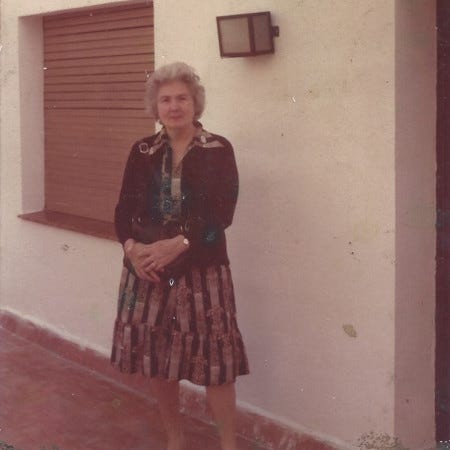
Photo by Pat Donnelly
Mary Donnelly, née Barrett, was the youngest of five children of a successful civil engineer, and a classic youngest she was, pretty, charming, admired by all, required to take responsibility for very little. She was, by accounts, a merry girl and a carefree young woman who larked her way through the WAAF during the War, looking fetching in her blue-grey uniform and quickly winning the attention of handsome young airman Pat Donnelly, whom she married a few years later, after he had sufficiently established himself professionally to be able to support a household. When the reality of domestic life arrived, it delivered a severe shock.
To many, Mrs. Pat Donnelly’s life must have seemed an enviable one. Her husband was handsome, her children were healthy, and she had never once had to wonder when the next pay check would be coming along. For Mrs. Donnelly herself, however, the picture was darker. Like many women of her generation, she had never had it suggested to her that she might pursue a career that would interest her outside the home; like many of them, sketchily educated and assured by society that they needn’t worry their pretty heads about matters of weight, she wouldn’t have known how, anyway. Which left her to her default profession, that of what is now called homemaking.
Mary was not a natural homemaker. She was bored by housework, and, depressingly, she knew she wasn’t good at it. Her children were large and untidy and always wanting food: she wasn’t noticeably good at preparing that, either. She tried to make up the shortfall by reading to us when we were small and joking with us as we grew older. But she was never comfortable in the domestic sphere; she never pretended to be.
I was the second of her five children and her only daughter, and as the testosterone count in the family rose, she and I became each other’s best friend. She was the most interesting and exciting person I knew, and I would follow her around the house, desperate for a conversation with her; she would talk to me about books, and her schooldays, and her teenaged crush on Tyrone Power; she would sympathize about the awfulness of school, but insist that I study hard nevertheless so that I could go to university and achieve the career that had been denied to her. We would laugh together about the males in the family; on soccer Cup Final day, when all five of them were ensconced in the living room with the blaring television, many bags of chips and their beverage of choice, we two would take ourselves to the Gaumont Cinema on Green Lanes for a matinée, preferably featuring Michael York, and a box of chocolates. It was all, really, lovely.
And then I grew up.
We all have our faults; and one of my poor mother’s was the particularly uncomfortable one of envy. It had been established during my young years that, amusing and endearing as I was permitted to be, it was she of the two of us who was to be the glamorous heroine, and I the dumpy sidekick: that she was to be Lucy and I Ethel, she Mary Richards and I Rhoda. When she turned around one day and saw that the awkward girl whom she had urged to study hard, to go to university, to pursue a career, had done all of those things and now had a happy life and a job she enjoyed and was good at – and all this, moreover, while having the audacity to look strikingly like her but thirty years younger – she did not like it one little bit.
Her jokes became brittle and sarcastic; she looked around for a weapon to remind us both of what she had that I did not, and quickly fastened on my, at the time, disastrous romantic life. She started to smirk and make pointed comments about “my husband,” and “my sons.” She would stand sideways in front of the mirror, pat her stomach approvingly, and say, “Not bad for five children!” She would hold tenderly hilarious conversations with the (spayed) family dog, Sally: “Yes, my darling, I know that you’d love to have a husband and puppies, what a shame you have no sex appeal.” I loved my mother, and must emphasize that for much of the time she was both lovable and loving. But good lord, she could be vicious when she had the mind to be.
Gradually, I stopped telling her about my life. I had learned that if I told her something difficult, she would become angry with me for not appreciating the good things; if something happy, I would be flaunting my perceived good fortune over hers. So, to keep the peace, I would slide back into Rhoda mode, listening to her doings and making admiring wisecracks about them, saying very little about my own. She never noticed this. She thought we still each made the other laugh equally.
I didn’t mind too much: Mary was Mary, I loved her anyway, and besides, I had other matters to occupy me. Like most writers, I had always dreamed of writing a novel: now, I had begun to do so, working hard and alone, creating, rewriting, correcting, creating again. It was brutally difficult work – and, as any writer will agree, one of the most inspiring forms of work you can ever luck into.
Meanwhile, Mary had begun to write a novel of her own. It was about her family, a colorful but quarrelsome bunch, to most of whom she no longer spoke because somewhere along the way they had offended her, but about all of whom she ruminated constantly, and with obsessive anger. The book was to be an unflinching exposé of the misdeeds of them all, and to say she was excited about the project would be an understatement. Mary was not a professional writer, and the atrocities she recounted consisted mostly of people irritating Mary: nevertheless, she was confident that the book would be snapped up for publication, confident that it would bring, not only glory to her, but, more gratifyingly still, mortal embarrassment to her kin. “There are going to be some red faces when my book comes out!” she would snort triumphantly. She could hardly wait.
When she had almost finished writing her book, I learned that mine had been accepted by the respected British publishing house Victor Gollancz. For me, this was a lifelong dream come true. For her, it marked the beginning of her decline.
For most of her life, she had kept a diary, a flimsy little pocket affair in which we would tease her for her daily jottings – “Monday: went shopping 9.30. Tuesday: Pope died. Wednesday: went to hairdresser 11.00.” On the day we heard about my book, the entry was, “Wonderful news! Gabrielle’s book accepted by Gollancz!!”
The entry for the next day was, “Feeling ill.”
In itself, this was not so remarkable. A sturdy peasant woman blessed with the constitution of an ox, Mary was a lifelong, card-carrying hypochondriac: regularly, she would announce, ringingly and in tones of faint accusation, that “I think I’ve got flu;” as regularly, a couple of days later, she would have seen something on the television that had made her laugh, and have forgotten about it.
Except that, this time, she didn’t forget. She stayed feeling ill for weeks. She went to her doctor. He could find nothing wrong with her. She went to another doctor, and another, with the same results. Nobody could find anything wrong with her at all. And yet, for the five weeks following the “wonderful news,” her diary entries ran, “Still feeling dreadful.” “No better.” “Had fight with Gabrielle.” (Oh boy, howdy, did she have a fight with Gabrielle during that time.) “Still feeling terrible.” “Had fight with Pat.” (It seemed it wasn’t only me: Pat later reported, remorsefully, that she was in so toweringly bad a temper throughout, that she had alienated even him). She went for tests. “I won’t mind,” she told me, darkly, over the telephone, “if they find something bad. I’ve had a good run so far.” The tests came back as clean as a whistle.
At last, desperate for an explanation, the family checked her into the local hospital for more exhaustive tests, where the doctors inexcusably kept her lying in bed, immobile, for several days. After about a week she was discovered – not altogether surprisingly after having been left lying on her back for so long – to have developed pneumonia. Vindicated, she sent Pat out to buy her a new toothbrush. Then, those days of lying inactive in bed apparently caught up with her, and she collapsed of a pulmonary embolism and died.
Of course I mourned her – she was my mother, for heaven’s sake – but as time has moved on, I have also started to ask questions. The timing of her illness was so particular, and she was only 65 and had been so strong beforehand. Was it simply a coincidence, or could it have been connected with my book? Could her body have been demanding an attention grab – and a most effective one, as it turned out – that then went horribly wrong? Could her daughter’s success have made her feel, literally, physically sick? Could she possibly have died of jealousy?
Am I ridiculously self-centered to want to connect Mary’s death with my own achievement? Many people might hoot with derision at so inflated an idea of my own importance; many people might well be right. But then, I look again at her diary. I knew my mother; I knew the force of her will and the ferocity of her competitive drive against me; and the story that the diary tells, of a furious woman unshakably insisting ill health when not a single doctor could find a single ill that ailed her, is a story that I cannot altogether ignore.
I’ll never know for sure. But it’s a very strange thing to be left having to wonder about.
This one merits a discussion of its own xx
Thank you for sharing this very personal and affecting story. Human relationship can be so complicated and difficult. I am sorry you were left with such a question and feeling. As Claire said, guilt is so often a part of grief. From the diary entry you shared, your Mom was obviously proud and excited of you for having your book published. So many real illnesses do not show up on blood work and routine tests, and remain a mystery to doctors still. It was likely a coincidence. I hope you can believe in her pride, and heal some of this between you in your heart. Sending big hugs!