


I have just seen the most appalling advertisement for Mother’s Day flowers.
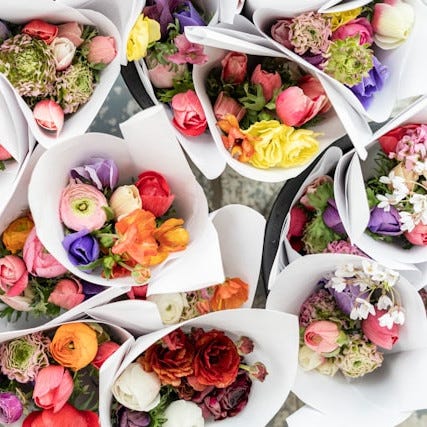
Photo by Zoe Richardson on Unsplash
It arrived in my in-box from an upscale local florist which I have used several times because they really do deliver the most fabulous blooms. It informs me that the reason why I should buy flowers for Mother’s Day this Sunday from them rather than from anyone else is because, they announce triumphantly, their flowers enjoy the superior benefits of having been – and I quote – “Grown by Mothers, Designed by Mothers.”
The women who tend their flower farms, they explain helpfully, are “most of them mothers themselves,” and by virtue of that, it seems, know better than anyone else when a flower is ready to be cut and when it needs a day more to reach its peak. And adds helpfully, in case I had not already fully recognized the source of their flower-pickers’ exceptional skills, “This is what we mean when we say Mother to Mother.”
As someone who suffers the ongoing sorrow of infertility myself, I am well accustomed to receiving implicit insults from society. I am hardened to being told that we non-parents “haven’t really grown up until you have your own little person to take care of.” That we lack the “superpowers that only a Mom is required to develop.” That no one “really knows what love is” before they have a child. And if I hear one more woman muse tenderly that motherhood has “opened a door in my heart that I never even knew was there,” I will personally produce a padlock that I will affix to the door of her smug maternal mouth.
This is the first time I have been told that my failure to reproduce has affected my ability to pick bloody flowers.
Everyone has their sorrows in life; and for Mr. Los Angeles and me, a major one is our childlessness. We knew going in that it was a possibility: I was over 40 when we married, and when we very quickly got pregnant, we were beside ourselves with joy. But we lost that baby, and later on another one, and in between went through what felt like centuries of hell: of hopes raised and dashed, of raging hormones and drugs that wreaked havoc on both of our emotions – I remember standing over Mr. Los Angeles at 2.00 in the morning screaming furiously that “This is not me! This is the drugs!” while the poor man begged to be allowed to sleep – of sitting in doctor’s waiting room after doctor’s waiting room while glowingly pregnant women accompanied by raucously healthy toddlers were excitedly welcomed into the office, only to have the nurse’s tone fall to glum resignation when my name was called. (“Why are you looking so down?” one nurse had the temerity to ask me. “Because I’m here for fertility treatment,” I explained, which appeared to offend her further). At last, we had no option but to accept what my own mother would have called God’s plan: that we were to remain childless.
Truth to tell, I have never fully come to terms with this. I don’t sit in a darkened room weeping from morning till night: I enjoy my life a great deal, and have in it a great number of people of all ages for whom I care deeply. But there is always a little pain in my heart too that I know will never go away; always a missing feeling that there should have been more in Mr. Los Angeles’ and my life than just the two of us; always a sad awareness that, coming as we do from a genetic inheritance that on both sides flourishes with fertility, the only family of which he and I have been capable will end with us and us alone.
I do not suppose for a second that I am the only person in the world to know disappointment, and it is not my intention to burden others with my own. But neither is it something I feel the need to keep secret; and what strikes me, when the topic does arise in a conversation, is the frankly quite strange reactions of some women who have been luckier than I have.
“Do you have children?” is a natural women’s conversation opener, and in the majority of cases, a safe one: most women who want children do have them, after all. Many non-mothers are what they cheerfully describe as child-free, which is certainly a valid personal choice, and, as many of them would point out, very possibly more responsible for the future of the planet, too. But for those of us for whom the truthful answer is, “We wanted to, but we couldn’t,” I wouldn’t have thought it too complicated for the questioner to offer a plain “I’m sorry,” to which I could then agree that life doesn’t always turn out the way we had hoped, and we could all move on to a different topic.
And so, to be fair, most conversations do proceed. However, there are also a surprising number of mothers for whom a simple response to my statement appears beyond even their superpowers. Some will smile consolingly under panicked eyes and mumble, “It’s not all roses, you know,” while surreptitiously scanning the room for their own precious tykes lest they should have been infected by my terrible condition and snatched into the void. Some will look waggish and quip hilariously that “You can have mine if you want,” which is a line they – although, curiously, not I – apparently find both original and very witty indeed. Some will evince a sudden and intense interest in the content of the canapés, the design of the curtains, the whereabouts of the cockatoo, anything not to acknowledge the unspeakable piece of excrescence I have inexplicably chosen to spew onto the thitherto immaculate floor of the conversation.
The most extreme of these reactions came, strangely, from a multi-awards winning Australian film actress I once interviewed while she was glowing and great with her third healthy pregnancy. I asked her – it seemed to me unremarkably enough, since her condition was blazingly obvious and she is famously happily married – how the pregnancy was going, expecting her to say something along the lines that at least with the third you know what to expect, I could tick that interview box, and we could progress to discussing her new film.
Instead – and to my astonishment, because it’s not usual interview protocol for the subject to ask questions of the interviewer – she abruptly asked, “Do you have children?”
Caught unawares, I gave my honest answer, which was, “Sadly, no.”
The acclaimed thespian – who, lest we forget, had asked the question freely and of her own volition – turned every shade of lobster known to the sea and physically gaped like a goldfish for several moments while she grappled with the unimaginable horror that was my daily existence.
(For the record, not all actors are like this. Anne Hathaway, now the happy mother of two, who, God bless her, has spoken with generous candor about her earlier fertility struggles, once gave me a crisp and professional interview on the topic, at the end of which she immediately threw her arms around me in a hug and said, simply, “I’m sorry for your pain.” That’s class.)
The truth is that my brave and unsung community of childless women needs neither your pity nor your embarrassment: what we could use is some plain old human recognition. No, we haven’t been through labor; we haven’t spend sleepless nights nursing teething babies; we haven’t fretted into the early hours about the behavior of teenagers. That’s the experience of mothers, and of course it goes without saying that they deserve a day to be spoiled.
But I would submit that a lot of us less lucky ones do a pretty darned good job on the sidelines, too, as aunts, as godmothers, as friends, as mentors: we do it without celebration – if there’s an official Godmother’s Day, I have yet to hear about it – and we do it smilingly, in the face of a heartache at which people who have successfully become parents can never even guess, that lasts the year around, that is particularly piercing around Mother’s Day, and that society as a whole simply refuses to acknowledge. I think we’re a pretty impressive bunch.
Some of us even know how to pick flowers.
So well said. If you think it would help build your audience, I could share it to facebook in a link. Let me know.
You’ve been a brilliant godmother to all of our children - thank you x