


The closest I had to a loving father figure was a priest, my Uncle Tony.
I had an actual father, too, and by many standards he was a good one. He was solidly married to my mother, he kept mostly moderate habits, and as the sole breadwinner for a family of seven, he worked tirelessly and with more than adequate success. He told me often and firmly that he was a “marvelous father,” and I am sure that by his lights, he undoubtedly was.
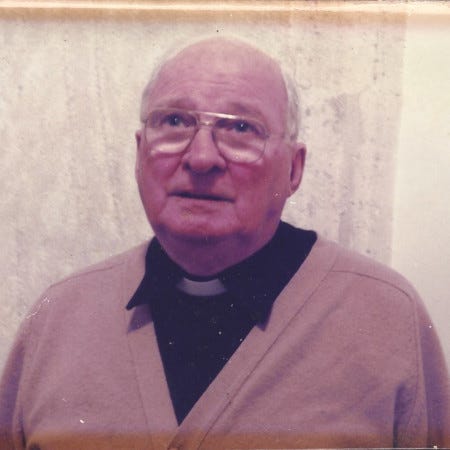
But he was also a man’s man to his bone, who saw no reason either why he should attempt to mask his preference for his four sons over his daughter, or, curiously, why he might expect that daughter’s feelings towards him to be colored by this. My father provided for me when I was a child, and when I was an adult occasionally said things that made me laugh; but he never made me feel particularly loved. Uncle Tony did.
The Reverend Joseph Anthony Barrett S.J, my mother’s eldest brother, stood 6’3” tall, and boasted a booming aristocratic voice and a commanding presence. He wore his spirituality proudly, and took his priestly duties with full seriousness – there are bad priests, yes, but there are good priests too, and he was one of them; but he also loved the world. He loved wine, and history, and good books, and word puzzles, and arithmetic, and astronomy, and gadgetry, and off-color jokes (he told me some ripe ones, and my male cousins report he told them even riper), and, most of all, telling stories.
Oh, lord, Uncle Tony loved to tell stories. He spent most of his life traveling between Farm Street, the British Jesuit mother church in London, and a range of locations in Rome, and had stories to tell from all of them. He told stories from Ancient Rome. He told stories from Tudor London. He told stories from his childhood. He told stories from the priesthood. He told stories that friends had told him from who knows where. At one point in his career, his superior, the Provincial, whom he had somehow offended (my mother’s family were blessed with many qualities, but tact was not among them), decided to punish him by sending him away for a spell from fashionable Farm Street to rainswept downmarket northern Manchester to be chaplain of the infamously bleak Strangeways Prison: to the surprise of both men – and I imagine the fury of the Provincial – Uncle Tony had the time of his life there, and came back with some of his best stories of all.
When Uncle Tony would visit our ragtag family branch in Palmers Green, it was an occasion. He would arrive at the door, rosy-cheeked with having been twittered over all morning by the nuns at the local convent, greet my mother with a kiss and my father, with whom he was very good friends, with a resounding bellow of “Hello, Broth-ah!” and we would all pile into the family car to be taken, exotically, to lunch at the Curzon restaurant on Green Lanes, where Uncle Tony would order the food in Italian from the waitresses. On one occasion, there was gooseberry tart on the menu. “Order it in Italian,” we asked Tony. He consulted with the waitress and they both shook their heads. “They don’t have gooseberries in Italy,” he told us. This was the first inkling I had had of a world so different from North London that gooseberries didn’t exist there, even in theory.
Uncle Tony liked me. He would ask me which books I was reading, and tell me stories of Roman restaurants where I imagined women in jewel-colored dresses wearing lipstick and smoking cigarettes. Once, after watching me struggle with cutting my chicken at the Curzon, he demanded we two ditch the car ride home so that we could walk past the butcher’s window where he could educate me in fowl anatomy. Used as I was to being ignored by the men in my family’s circle, I for years found this avuncular attention confusing, even a little alarming. It wasn’t until later that it occurred to me that it was, in fact, really rather nice.
When I was an adult, I began to visit Uncle Tony in Rome. His Italian was fluent, but I hadn’t realized, I at first thought, how pronounced his English accent was. “I-o son-o Padre Barrett,” he would introduce himself delightedly to puzzled strangers on the banks of the Tiber, and to their further befuddlement proudly including his niece in the introduction, “e cuest-ah è mi-ah nipot-ah.” It was only when I met him again in London that I remembered that, when ordering food in Italian restaurants there, his accent became worthy of Petrarch.
One of my brothers swears he once accompanied him to a trattoria in Soho, where they were waited on by an olive-skinned and Botticelli beautiful young man whom Tony addressed in a mellifluous speech in which the terms Roma and bottiglia di vino featured prominently, only to have the youth reply in broad and apologetic Cockney that, “I’m sorry, Farver, I don’t speak Italian.”
Bad Italian accent or good, his company was fabulous. And he drew towards him an array of other colorful characters – American heiresses, Italian politicians, retired Colonels, Sixties drop-outs, scholars, artists, and prison workers – and loved nothing better than including his beloved nipota in their midst. Time after time in Rome, my feeble suggestions that I might visit, for instance, the Sistine Chapel were brushed aside with a breezy, “You don’t want to do that, sweetie, it’s full of bloody too-rists. Come and have lunch with the contessa instead.” To this day I haven’t seen the Sistine Chapel. But I’ve had some remarkable lunches.
Before Mr. Los Angeles and I got married, I took him to Rome to meet Uncle Tony. Tony was polite but wary: he liked most Americans, he enjoyed their directness and humor, but this one was planning to marry his nipota, and the stakes were high. One morning, when he was leading us through the Centro Storico, expounding on the use of concrete in the Pantheon, he noticed Mr. Los Angeles, who is a talented amateur photographer, busily capturing a nun eating ice cream.
“Are you still taking bloody photographs?” he called across the ancient cobblestones. “You look like some bloody American too-rist.”
Mr. Los Angeles beamed upon him a sunny Californian smile.
“Well, Tony,” he explained genially. “I am a bloody American tourist.”
There was a pause while respect dawned gradually in Uncle Tony’s eyes.
“Ah,” he said then. “Right. Carry on.”
Uncle Tony loved me; but he also loved my father, and it saddened him deeply when we two became estranged. Being a man of his generation, he naturally took my father’s part, and wrote me a number of letters reminding me to honor my father and my mother, and quoting Christ’s injunction that if someone strike me on one cheek, I should turn the other. I think even he realized that this last was not what you’d call a ringing endorsement of a caring parent, and when I wrote back that after turning and turning again, I could surely be forgiven for at last walking out of the room, he (mostly) dropped the argument. It was the closest we two ever came to falling out.
The last time I visited Uncle Tony was for his ninetieth birthday celebration in Rome. This was an affair several days long of cousins and friends and lunches and dinners and a large and riotous party, at the end of which he made a speech culminating in a lengthy joke whose punchline was “hemorrhoids for the h’aristocracy.” (You probably had to be there). Mr. Los Angeles captured the session on his handheld computer, with which Tony was fascinated, and he remarked, wistfully, that, had he been younger when computers came along, he would have very much enjoyed learning to use them: I can just see him now, slamming the latest model exultantly onto the kitchen table. “I say! Look at this!”
The very last time I said good-bye to him, we were standing outside the sacristy of the Chiesa del Gesù, the Italian Jesuits’ mother church that over the years had become, along with the Irish pub across the street and the Ristorante Abruzzi ten minutes’ stroll away, his personal fiefdom. The previous night, we had had, once again, the inevitable discussion about my father, and had come, once again, to the inevitable consent to agree to disagree. Now, he looked down at me from his tall, familiar height, lifted his chin across the church towards Mr. Los Angeles, busy examining the carpentry work on one of the confessional boxes, and cleared his throat.
“You happy, sweetie?” he said.
This was not a question it had ever occurred to my father to ask.
“Yes, Uncle,” I said. “I’m very happy.”
“Good,” he said. And that was that.
He died a couple of years later, of what he ruefully described as “a bad case of anno domini.” He spent his last few weeks in a nursing hospital in Rome, being cared for by nuns, who allowed him to have wine in his room, with which he entertained the series of visitors who came to pay final court.
“Are you frightened?” one of them asked him.
“No,” he replied thoughtfully. “I’m curious.”
One morning, he woke up, and said to the nun who was tending to him, “Io parto oggi” – I’m going away today.
“È Dio che decide, non Lei,” the nun told him. That’s God’s decision, not yours.
They were in the middle of debating this when he died, having had, for the last time, the last word. It was March 19, the feast of St. Joseph: not only his name saint, but the patron saint of a happy death
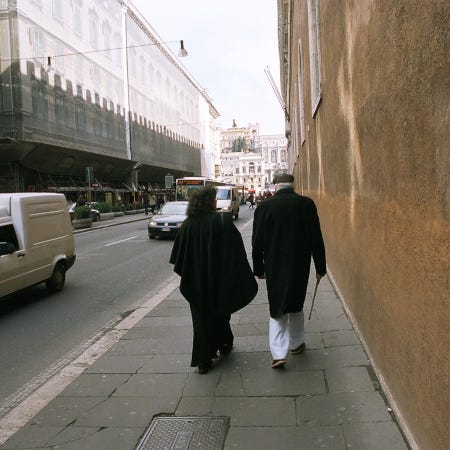
.Photo by Owen Bjørnstad
His funeral was in the Gesù, and a splendid occasion it was, with multiple priests on the altar and eulogies in both Italian and English: I attended with a group of cousins and we were made much of, being i nipoti, the representatives of the family which had given Padre Barrett to the world and to Rome. After the ceremony, the long, long coffin – Uncle Tony had never shrunk physically with age – was driven to a mausoleum in a cemetery on the outskirts of the city, where it was placed in a crypt: this was apparently a mark of honor, although I didn’t like leaving him there, it seemed far too cold and lonely for my sociable uncle. But he himself would remind me that what is in the crypt is only a shell: the important part of Joseph Anthony Barrett is off somewhere else now, I hope having his curiosity satisfied.
The next day, I went back to the Gesù, and for the first time in all the countless other times I had visited, was struck by how darned big it was. And it is massive – 75 meters long and 35 meters wide, abundant with high altar and side chapels, lavishly decorated with gold leaf and bronze, tall marble pillars, and soaring frescoed ceilings. The guide books now tell me it is one of the most impressive Baroque edifices in all of Rome.
It had just seemed so much smaller with Uncle Tony in it.
This was such a lovely tribute, Gabrielle. Here's to the Uncle Tonys all over the world!
That was such an entertaining read, and a thoughtful and touching tribute to your wonderful uncle. Who needs biological children if one has such a loving niece.