


I was at the Cannes Film Festival with a bunch of British journalists and feeling lonely.
This was not in the least degree the fault of the journalists. They were delightful people, as the majority of my ragtag colleagues are, friendly, funny, and with stories to tell they could sell by the yard. My problem was that the company into which I had, by an involved set of circumstances, fallen was exclusively British, and, as far as they were aware, so was I. So their conversation, inevitably, revolved around Britain: British politicians, British TV shows, British in-jokes and cultural references which sailed as far above my Southern Californian head as the high clouds float over Dover Castle.
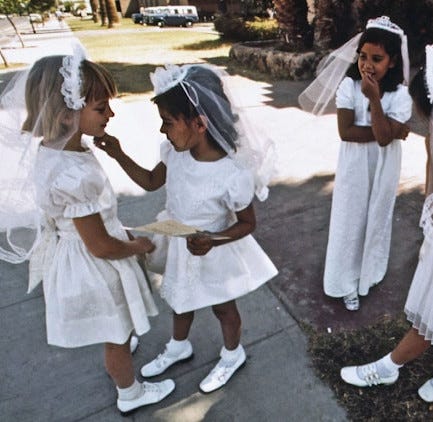
Photo by Documerica on Unsplash
My own keen journalist’s nose for a story had already ferreted out the information that when British people get together, they might reasonably be expected to talk about matters British: however, when I meet a group of them these days, it is usually when they are visiting America or I Britain, in a setting in which I have already been identified as someone who lives in Los Angeles; and, while I obviously don’t expect them to tailor their entire conversation exclusively towards me, there is nevertheless an awareness – even occasionally some interest – that my current frame of reference is different from theirs.
All that these people knew about me was that I wrote for a British magazine, and my stubbornly British vowel sounds give no clue that I might live anywhere much west of Shepherd’s Bush. To them, I was simply someone who talked with the same accent that they did, but had remarkably little to say in it: someone who was, at best, extraordinarily dull company, and, not entirely implausibly, also suffering from a brain damaged by extreme and relentless drug use. Had anybody ventured to ask me a question about myself, I could have maybe had the chance to explain my situation. But since to the average Brit, asking a personal question is somewhat on the level of disgorging the contents of one’s breakfast over the Royal Crown Derby bone china at afternoon tea, the only way I could realistically have broken my silence would have been to leap onto a tabletop and shout, “Hear ye, Hear ye, I live in California and have no idea of half of what you’re all talking about.” So I stayed quiet.
Which left the other option, of talking to French people. In usual circumstances, I very much enjoy talking French, and, while far from fluent, can generally make myself understood for an entertaining enough conversation. My family were good friends with the tough-minded order of Breton nuns who taught me at school – I was even named after one of them, Mozzair Mairy Gabriel, who met my pregnant mother one day outside Palmers Green train station and ordered her, if ze bébé were a leetle gerrl, to name her after the Archangel Gabriel, and when Mozzair Mairy Gabriel said “sautez,” one sautait – I’ve heard French spoken around me since childhood, and am usually relaxed and happy to join in. Usually.
The Cannes Film Festival, however, showcases, not only films from all nations, but also French bureaucracy. Tickets to screenings require a degree in astrophysics to secure, and invariably, for my hopelessly disorganized self, involve standing in the wrong line, wearing the wrong color badge, and being shouted at by one or another ferociously stern Frenchman to turn around and go là bas, là haut, à gauche, à l’autre porte, up to la claire fontaine, across le pont d’Avignon and often stopping off to pick up la plume de ma tante along the way. It is exhausting simply to decipher – let alone feel inclined to seek out more conversation on top of. So I kept quiet there, too, and as the days passed, began to feel the waves of loneliness lapping ever more insistently at the shore of my own personal ever more desert island.
On the Sunday morning, I found myself at a loose end in Festival terms, and walking past a church and seeing Mass about to start, I decided to slide in and attend. As soon as I entered, I felt my shoulders begin to relax. I’ve been being prayed over by Frenchwomen since, very possibly, before I was born, and know au nom du Père et du Fils as well as I know how to make the sign that goes with it; although these days far from a regular church attendant (sorry, Grandma), I also know what Mass is about, when to stand and when to kneel, what is happening in it now, and what is about to happen two prayers down the line; after a while, the comprehension dawned on me that, for the first time since I had arrived at the Festival, and being now neither shouted at in French nor talked over in British, I actually understood what was going on. It was really quite refreshing.
And it was to get better. It turned out that this Mass was not just any old Mass, but the most tender and touching form of Mass that you could ever hope to stumble upon in the church year. It was the children’s First Communion Mass.
To say that Catholic children are excited about making their First Communion is akin to suggesting there might be the occasional hole in Blackburn, Lancashire. The Catholic Church teaches that during Mass, each Communion wafer is quite literally transformed into the actual body and blood of Jesus Christ. This is admittedly an unusual sort of assertion, that adults may argue for as long into the night as they choose: for children, however, it is simply another new piece of information, and a thrillingly magical and mysterious one to set against the other facts that are presenting themselves, like the eight times table and the inexplicable spelling of Wednesday.
First communions are a big deal: they happen en masse, at a specified Mass during the early summer of the school year the children turn 7, and for the weeks leading up to it, the children’s lives are given over to its preparation. They attend special lessons dedicated, not only to the meaning of the sacrament, but also, in this excitingly grown-up and responsible new spiritual world they are about to enter, to the technique of receiving it: how to file out of the pew in an orderly line to approach the altar, how to take the small round wafer in the hand or directly onto the tongue in an appropriately reverent fashion, how to slide it past the palate and swallow without biting on it (a practice session will have been involved with unconsecrated wafers brought dramatically in from the church itself), how to return to the pew and immediately kneel down to say prayers of thanksgiving for the miracle in which they have just partaken. The anticipation is intense.
The day itself is one of glorious celebration. The boys will wear new suits, the girls, white dresses with wreaths of flowers in their hair over which their mothers have been agitating for weeks. Relatives will descend to make a fuss of the communicant and the communicant alone (this a first and incontrovertibly last experience in my own family of endless cousins), and there will be presents galore – sometimes, even, too many: I was given a white-covered prayer book by my grandmother and one similar but not identical by my godmother, which provoked hours of agonized choice every Sunday morning thereafter because we all went to the same church, and what if one of them noticed me using the other’s gift instead of her own? There’s a jubilant procession to the specially reserved front pews of the church, and a big celebratory breakfast – featuring orange juice, no less – afterwards. It’s not quite a wedding day: but for a 7-year-old, it’s not so far behind, either.
For the adults in the congregation, to see forty or so 7-year-olds, all dressed in their angelic finery, first tiptoe nervously to the altar, and then bounce back to their pew, bursting with the sheer magic of what they have just done, their eyes triumphantly seeking out their families to confirm the heady reality of it all, is a sight against which some hearts might manage to remain proof, but I would estimate not many, and certainly not mine. It was drama that by far outshone anything I had seen on the film screen all week long; and best of all, I understood every single element of it. I was overcome with joy: stick a white dress on me and a prayer book in my hands, and you’d have been hard put to tell me from the First Communicants.
After the Final Blessing, I floated from the church, made a quick pit stop at le tabac to buy a replacement package of paper tissues, and took the bus into town to meet the Brits for lunch.
“What did you do this morning?” one of them asked me.
“Well!” I began, and then stopped. Although the famed British upper lip has softened considerably from that sported by previous generations, it is still not precisely what you’d call tremulous; and the British approval rating for disclosure of church attendance is below even that for personal questions.
“I went for a walk,” I said at last. It seemed simplest.
It puzzled me for the longest time, Patricia! The other one that threw me - to continue the sacramental theme - was "breakfast," because, while obviously I ate brekfust every morning, the only meaning I had ever heard attached to "break fast" was that it was what you did after avoiding food for three hours before Communion, and these people who were eating it in the story books didn't even seem to have gone to Mass! There was a whole confusing world waiting for me out there, but thank you for the kind comment on the post.
The inexplicable spelling of Wednesday. It is time it was called out! Lovely piece