


It was a late summer day in the 1980s, and, after a couple of years of criss-crossing the Atlantic in increasing uncertainty, I had at last made my decision and was on my way from my native London to live, permanently, in Los Angeles.
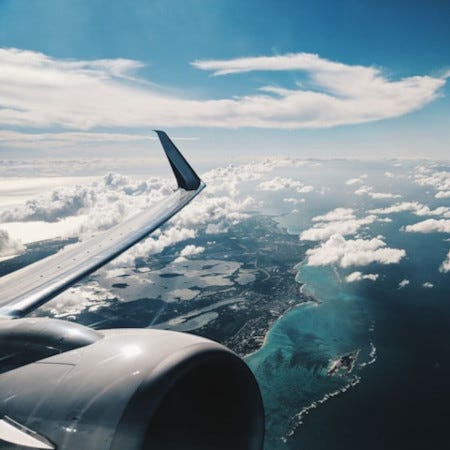
Photo by Patrick Tomasso on Unsplash
The previous couple of weeks had not been easy. There is no delicate way to tell your loved ones that you have decided to inhabit a different continent from them, and the time had been fraught with tears, recriminations, and accusations of failure, in love, in friendship, in family loyalty. Oh, dear, I hear you murmur kindly, that must have been challenging. And I’m sure it undoubtedly was, for those on the receiving end. But since I was the one doling out the abuse, I’m really not the person to ask about that.
The truth was, that, having made one of the biggest – although as it would prove, one of the best – decisions of my life, I now had no idea of how it would turn out. Cautionary tales abounded in London of people who had eagerly swapped gloomy England for sunny Spain, or sophisticated Paris, or buzzy New York, only to receive a harsh shock when the reality of day-to-day life there sank in; and, yes, I knew Los Angeles well enough to know that I liked what I saw of it, but on the other hand – setting off as I was to a place with no living accommodation arranged, no friendships that were older than a couple of years, and a freelance journalist’s career that had never claimed to offer stability – how well did I know it really? As I handed over to the Heathrow departures desk the venerable blue suitcase that contained all of my possessions, picked up my portable typewriter and the passport containing my foreign journalist’s visa stamp, and made my way onto the plane, I was composed enough to go through the necessary motions; but you would never have confused my temperature with that of a cucumber.
I had a nice surprise soon after the plane took off. Two of my very dearest London friends, and two to whom I had therefore been particularly unpleasant a couple of nights before, had sent me – and in those dear lost hedonistic days had been allowed so to do – a bottle of chilled champagne to speed me on my way. Well, this was the way to do it, I thought, offering a glass to the man sitting next to me, who took it as a cue to open a conversation of so spectacular a level of tedium that I limited him to just the one glass and kept the rest for myself.
I can’t now remember why I had booked a flight that changed at Boston instead of taking my usual direct flight, but it’s just as well that I had because it meant that even I didn’t have time to drink the whole bottle. Nevertheless, I had made a respectable inroad by the time I disembarked from one plane, waved my visa in front of the immigration officer, and ambled, hazily and in admirable time, onto the next, there to kick off my shoes, pull on my flight socks, and settle myself in for a peaceful pre-flight doze.
Only to be roused by a stern announcement coming over the loudspeaker. Would Miss Donnelly please make herself known to the cabin attendants?
When Miss Donnelly did so, she discovered that the cabin attendants were not best pleased with her. Had Miss Donnelly not been aware that when she went through immigration at the airport, she had also been expected to check her luggage through customs? (In fact, I hadn’t: this was the first time I had used a flight that required me to change planes, and the question of where to clear customs had not occurred to me). Because the customs officials were now holding a suitcase that had Miss Donnelly’s name on it, that she needed to claim, have inspected and loaded onto the plane before the plane could take off, and would she please consider doing so, like, right now?
Still in my socks, I slunk in disgrace past the accusing eyes of my fellow passengers, off the plane, down the hallway of the airport and to the customs desk. The customs officer was burly of build and commanding of presence. He was also, it became immediately apparent, the latest recruit to the growing movement of people who were unhappy with me that day.
“Why didn’t you clear your luggage?” he demanded.
“Sorry,” I mumbled. “I’m changing planes and I didn’t know I had to do it here.”
The officer – whose life, after all, revolved precisely around the customs desk – stared at me in incredulity.
“You didn’t know,” he repeated slowly, “that you were required to clear your luggage at the port of entry?”
Amid the ravening horde of questions that had rampaged through my mind over the previous few weeks – of my life, my future, my career, my duty, my heart, my happiness, my community, my nationality, my very identity, for heaven’s sake – somehow, that of whether I should clear my luggage in Boston or in LA had failed to register.
“Sorry,” I said. “I really didn’t.”
I didn’t catch exactly what the officer said under his breath; but I received the impression that he was not admiring my accent.
“Well, remember it next time,” he said then. “OK, let’s see what we got here.”
He bent to examine the idiot woman’s suitcase. I was, in fact, particularly fond of that suitcase. It was roomy, and a comforting shade of blue, and had traveled with me to all sorts of lovely places – to America, now, several times, and also to Spain, and to Ireland, and to Rome and Paris and Edinburgh and to all manner of delightful destinations where I’d had all manner of delightful times. It was, by now, a very dear old friend.
A very dear, and a particularly old friend, as the customs officer discovered when he grasped the slider of the zip fastener to open it, only to have the entire slider – not just the pull tab, but the catch-box that slides through the teeth to open and close them – detach itself completely and fall apart in his hand.
The officer gazed at it, his incredulity now amplified to sheer stupefaction
“How am I supposed to open it now?” he asked.
“I don’t know,” I said. “I don’t think you can.”
As I stood there, shoeless, no longer a Londoner but not yet even arrived in Los Angeles, with a planeful of irritated people behind me, an unknowable future ahead of me, all of my worldly goods stuffed into a broken suitcase, and an irate customs officer who would be well within his rights to force open the suitcase and fling all of its contents pell-mell around the area, it occurred to me that this was, hands down, the single most amusing thing that had ever happened to me in the course of my entire life.
I laughed. I howled. I doubled over in mirth.
The officer regarded me stone-faced.
“You think this is funny, huh?” he asked after a moment.
I saw little point in attempting to deny it.
“Yes,” I wheezed, all but speechless with merriment. “I do.”
The officer regarded me for a few moments more, then frowned sharply as his attention was caught by a ticking sound coming from the case.
“What’s that noise?” he said.
This was getting better by the minute.
“It’s my alarm clock,” I spluttered delightedly.
He continued to look at me. This was the 1980s, when the Troubles in Northern Ireland were raging, and here he was, a customs officer in Boston Logan International Airport, confronting a passenger with a British passport, an Irish name, and a broken suitcase with something inside it that was ticking loudly. I simply could not believe my good luck.
“Your alarm clock,” he repeated.
By now I was beyond speech.
One by one, the officer considered a variety of reactions; one by one, he discarded them all.
“Lady,” he said after a few more moments. “Where are you headed?”
It took me a couple of tries, but I at last was able to locate my vocal chords.
“Los Angeles,” I whimpered, clutching my sides in glee.
The officer sighed.
“It figures,” was all he said.
He handed me my suitcase and sent me on my way. And so I shuffled, still in my socked feet, still chuckling, and tenderly bearing with me my weary and broken baggage, back to the plane that would carry me off to my thoroughly lovely new life.
An alarm clock 😀 Talk about them suffering from a sense of humour by-pass!
Oh, yes I like this. Holy sheet! What a savage tale and it was told so well. I’m glad your life afterwards was lovely.