


Some years ago, I co-wrote one of the first sequels to Pride and Prejudice. It was very many years ago, in fact, in the days before Colin Firth had stepped out of a lake in a wet shirt and the world had gone Austen-wild, back when Jane Austen was still a dust-encrusted name on the Classic Literature shelf, and everyone told us it was such a crazy idea that we’d never find an agent, never mind a publisher.
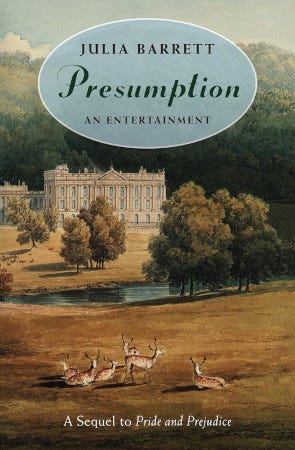
My co-writer was a local arts journalist, some years older than me, called Julia Braun Kessler, who had had the idea but needed a collaborator with experience in fiction and a grasp of British English to help translate her vision to the page. We took her first name and my mother’s maiden name, called ourselves Julia Barrett, and had the time of our lives researching the period, aping the literary style, and arguing ferociously over whether to write “gentlemanlike” or “courteous,” or “features” or “countenance,” or how often you could repeat “she said” during a conversational passage without becoming boring (Julia liked to vary it, I held that more obtrusive verbs were simply distracting).
At the inspired suggestion of Julia’s husband Jascha, a poet and professor of literature, we called it Presumption, partly in a nod to the audacity of our project, and partly because the plot had Darcy’s younger sister Georgiana somewhat irritatedly falling in love with a plainspoken member of the meritocracy. Despite the forebodings of the naysayers, it did get published, and while we narrowly missed winning that year’s Nobel Prize for Literature, it is still in print today, and I even receive the occasional royalty check in the mighty double digits, which never fails to cheer me.
The Jane Austen Society of the time were appalled at our effrontery. Pearls were not so much clutched as grasped in a stranglehold, sofas were fainted alternately onto, and the cry went out, in tones worthy of Lady Catherine de Bourgh herself, that two writers in Los Angeles, of all unspeakable places, had “tampered with a masterpiece.” I imagine the organization has clambered at least partially down from its high horse since the advent of Pride and Prejudice and Zombies; but at the time, the name of Julia Barrett in Austen circles was synonymous with the very muddiest of brash Californian mud.
We didn’t mind too much about this. I had already reached the private conclusion that, for all of Jane Austen’s literary genius, she was also an unpleasant little snob; and besides, we’d soon fallen into much more congenial company with whom to pass the time of day.
There was at the time in Los Angeles a thriving section of society known as the ladies who lunched. These were the wives of the rich men: women of leisure with time on their hands and bottomless bank accounts, who were more than happy to shell out a donation to a good cause in exchange for an indifferent lunch at a fancy hotel and the thrilling opportunity to rub their designer-suited shoulders with the more shabbily clad scapulae of a couple of real live authors. Julia, who seemed to know everyone in town, had added our names to the lists for these events, and when Presumption was first published, we spent a most happy six months going from venue to venue, reading, speaking, signing book copies, and generally making ourselves irresistibly attractive to one and all. Jascha used to call us the dog and pony show.
The ladies who lunched were sweethearts. They were possibly not what a nitpicking observer might describe as women of towering intellect; but they didn’t claim to be, and besides, I’ve been around a few towering intellects in my day, and good lord, do they know how to tower. These ladies were friendly and unpretentious, and would gather eagerly around Julia and me, themselves fresh from vacation travel in private jets to fabulous hotels in exotic places, dripping jewels that could have bought and sold the both of us and our entire social circles several times over before breakfast, expressing nothing but enthusiastic admiration that any person could manage to put together two consecutive sentences, let alone a whole bookful of them. Their souls were as sweet as honey, and we had a wonderful time among them.
One day, Julia telephoned me in some excitement. We had scored the prize, she announced triumphantly, an invitation to Edna Lillich Davidson’s monthly Luncheon Salon at the Beverly Hilton, hosted by no less a luminary than Edna herself.
“That’s nice,” I said, politely.
There was a pause while Julia suppressed a sigh.
Edna Lillich Davidson, it seemed, was the leading figure of the Los Angeles literary scene; her … not merely lunch, you will note, but the full-on Luncheon … Salons had been the hot Los Angeles literary lunch ticket since the 1950s, they had hosted every important writer in town, this was a very big deal indeed, and was there any way in the world, in honor of just this one occasion, that I might under any method of persuasion even consider wearing make-up?
So up we both trundled on the appointed day, I cosmetic-unencumbered but spanking clean and sporting a cute British accent to boot, to do our double act. Edna Davidson was magnificently regal in bearing and thoroughly charming in manner, and if some might have questioned the decision of a woman who would not see 70 again to dress herself in the garb of an eighteenth century milkmaid, I quickly reminded myself, looking down at my own trusty attire, that I was hardly in a position to debate the sartorial choices of others. We chatted, we mingled, we were shown to our seats at the table of honor at the very front of the room, which we shared with Edna herself and the other guest, Buddy Ebsen, on-screen Jed Clampett of The Beverly Hillbillies, off it an elegant and engaging man, full of stories of the time he had nearly played The Tin Man in The Wizard of Oz.
Our presentation was a roaring success. We made a good pairing, we two, Julia the tall and soignée native New Yorker who had seen it all, I her more Bohemian London-born counterpart. We read passages from the book; Julia gave a brief summary of Austen’s life and works; I compared my own life as single woman in the late twentieth century to that of Austen in the early nineteenth. We fielded questions and raised some chuckles. It was all going, so, so well.
I just wish someone had warned me of what would happen next.
After the presentations, an expectant hush fell over the jewel-bedecked audience. Then Edna rose gracefully from the table, made her way to the stage, and positioned herself at its center.
“And now,” she announced ringingly, “it is time for the Broadway section of our salon.”
A hum of anticipation ran through the room: this was plainly the high point of the occasion. Edna smiled, graciously, in acknowledgement.
“This month,” she said, “our musical selection is Rodgers and Hammerstein’s beloved work, Oklahoma!”
The hum grew.
“So,” added Edna, “without further ado …”
She thrust a dramatic arm to a not-young man sitting at a piano, who obligingly produced just two or three chords before falling even more obligingly silent. Then she drew herself up to fix her eyes upon a spot somewhere several inches above the audience’s collective head.
“There’s a bright golden haze on the meadow,” she observed, dreamily.
She paused.
“There’s a bright golden haze on the meadow,” she repeated firmly.
She paused again.
“The corn,” she continued, “is as high as an elephant’s eye. And it looks like it’s climbing clear up in the sky.”
Another pause while she gathered her resources.
“Oh!” she cried then, in wonderment. “What a beautiful morning!”
And, yes, here it came,
“Oh! What a beautiful day!”
It was at this point that I realized that this generous and warm-hearted woman, who had invited me to her gathering and been nothing but delightful to me since I had arrived, was proposing to recite, con brio and employing perfect elocution, the entire lyrics to Oh, What A Beautiful Morning, and very possibly, given her assured command of the stage, to every single song in the Oklahoma! score.
And … oh, reader, the shame … I lost it. I suffered a full-on attack of the giggles: the sort that starts in your belly and works its way up through your chest to your vainly pursed lips, and your body shakes and your eyes tear up and your face turns purple, and try as you may you cannot suppress the eruptions of mirth that will burst from your throat.
It was terrible. It was frightful. It was the worst such attack I had had since the Fourth Form French lesson when Maureen Gallagher had drilled her pencil into my back and whispered, “Am I boring you?” except that then I had been simply a naughty schoolgirl who could be sent to the corridor to calm down, and here I was a grown woman, a featured author on the top table, no less, with the eyes on me of a roomful of perfectly nice women who had been looking forward to this afternoon with keen anticipation, and the impeccably gentlemanly Buddy Ebsen, and (oh, God), my increasingly infuriated writing partner, as I descended further into disgrace.
I tried everything. I tried thinking of rotting fish, of abandoned puppies, of Beth dying in Little Women. I tried counting backwards from 100, and composing my grocery list, and naming all American states in alphabetical order, which last did work for a while until I reached the letter O. At one point, I decided to go with the flow and pretend I was finding the recital so affecting I was moved to tears: I extracted a tissue from a pocket and raised my head to dab delicately at my eyes, only to be confronted by Edna, now in full flow, ethereally listing the qualities of “that … shiny … little surrey … with the. Fringe. On. Top,” whereupon I disintegrated again.
I truly couldn’t tell you how long the experience lasted. I don’t know if Edna went through the whole production: I know she did Beautiful Morning, and the Surrey With The Fringe On Top, and Kansas City (“it’s better than a magic-lantern show”), and I’m quite sure – although memory has mercifully blocked the details – that she did People Will Say We’re In Love. I do know that when she at last reached the grand finale of pumping her slender fist into the air and crying, “Oklahoma. OK!” I was wrung out, exhausted, destroyed, and that Julia was looking at me with, not so much daggers, as a whole armory of pointed instruments from poignards to stilettos, of which she was visibly calculating which to use on me first.
Julia declined to walk out with me. Edna bade me a most cordial farewell, my only consolation – because she was a really lovely woman – being that in her absorption in her performance she had apparently failed to notice my reaction to it. Buddy walked me to my car: a class act to his fingertips, he behaved for all the world as if the previous hour had simply not happened.
Julia did not talk to me for days. She also stopped signing us up for literary lunches; I missed hanging out with the sweet rich ladies, but could not in any honesty blame her.
This is delightful! I didn’t know about your Jane Austen novel, and I love the title! Will have to get a copy!
Too too funny. I would have peed my panties! And that it was song after song after song, hell I would have been on the floor. You didn’t mention Poor Judd is dead…I can only imagine