


“I went to English afternoon tea at that new hotel,” she said.
“That sounds nice,” I said.
“It was real fancy,” she said. “We had smoked salmon and cucumber sandwiches, scones and jam, and those cute little pastries, all laid out on fancy plates, each of us with our own little pot of Earl Grey tea. It was a real high tea, you know?”
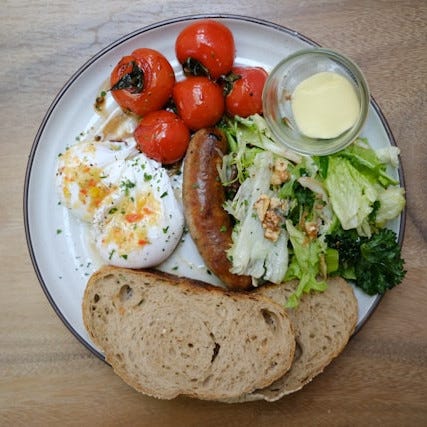
Photo by Cici Hung on Unsplash
“Ahem,” I said. “If that was what you had, then it wasn’t high tea at all. It was afternoon tea.”
“No, it was high tea all right,” she said. “Cream with the scones and a glass of champagne on the side. It couldn’t get much higher if it tried.”
I poured her a cup of Trader Joe’s Irish Breakfast (sturdy Assam, and a steal at $3.49 for 80 bags), and passed her the plate of ginger snaps.
“Let me explain,” I said.
Contrary to what some American establishments with pretensions would have you believe, a British high tea is not simply a fancier version of afternoon tea: the two are, in fact, completely different animals.
Perversely, it is the plainly named afternoon tea that is the aristocratic one. Famously invented by the nineteenth-century Duchess of Bedford, who found herself growing peckish between lunch and dinner, it features fine tea, elegantly served in prettily patterned cups, delicate sweet pastries, and, crucially, the cucumber sandwiches of which the prototypical upper-class twit Algy of The Importance of Being Earnest had absent-mindedly scoffed a whole plate while he was waiting for Lady Bracknell. Although afternoon tea is now taken through all levels of British society – and some would submit that the further down the social scale you go, the better the food becomes – its origins are most firmly patrician.
High tea, on the other hand, came about solely for us honest workfolk: the evening equivalent of brunch, it is a proudly down-home, vigorously well-earned cross between late tea and early supper that was traditionally offered to farm workers when they plodded home, weary and hungry, from the field.
The difference in the terminology between the two meals arose, in that curious and eccentric way that so many British institutions do arise, from seating arrangements. When the toffs took their afternoon tea, from the nineteenth century and into the Downton Abbey era and for all I know even to this very day, they would take it in the drawing room, reclining on sofas and easy chairs and languidly observing as the serving folk stooped with the backbreaking obeisance fitted to their station in life to set out the meal on the low occasional tables that dotted the room (one can only imagine Violet Crawley’s reaction to the term “coffee table”), from which the high-born could enjoy their refreshment along with their favorite conversational topics of comparing lineages and complaining about the lower classes. The workers, meanwhile, continued to take their high tea as they had taken it since time immemorial, sitting upright at the regular height kitchen table, their knives and forks clasped eagerly in honest calloused hands, their appetites sharpened by righteous labor, their consciences as clean as Lord Grantham’s starched shirt cuffs.
High tea is flat-out delicious. It feature hearty and wholesome treats such as ham and eggs, local sausages or cold meat leftover from the Sunday roast, maybe a slice of pork pie, a hunk of local cheese and plenty of the jarred relishes that British people call pickles, celery sticks or a bowl of tomatoes in the summer, all teamed with doorsteps of sturdy fresh bread and slabs of creamy butter to mop it up. If you’re lucky enough to have some cold cooked potatoes to hand, you might have those sauteed in butter or bacon grease on the side, or if your ship has really come in and you have both cooked potatoes and cooked cabbage, that artery-stopping ambrosia of crusted vegetable hash called bubble and squeak.
There’s sweet stuff on the table too, but it’s not the kind you’d balance on a tiny plate to eat with a dessert fork. It’s more likely to be a wedge of pie – rhubarb in the spring, gooseberry in the summer, apple or – oh, be still my heart – apple and blackberry in the autumn. As it’s coming up to Christmas, it might be the traditional mixture of chopped fruits, spices and one hesitates to imagine what else called a mincemeat pie, which, to my personal palate, is very tasty indeed if you like that sort of thing, and I’m delighted to report that it’s there for those who do.
Whatever the season, if someone’s feeling kind-hearted, they might have baked a cake. It might be a fruitcake, but, happily, not the mud-colored excrescence that for reasons of their own Americans will foist on the unwary at this time of year: the British fruitcake is offered all the year around, a still hearty but mercifully lighter affair, studded with the plump golden raisins which British people call sultanas and sometimes, as reputedly preferred by Winston Churchll, no less, with glacé cherries. If you’re in the north of England, there might be gingery parkin. In Scotland, there must be shortbread – my Scottish friend Aggie has given me her recipe and it tastes delicious but I can never get the mixture to stick together, it must be a south of Lanarkshire thing.
All of this delectability is washed down by gallons of tea. It’s not Earl Grey tea or Darjeeling tea or Lapsang Souchong tea – it’s just plain old tea, and is poured copiously from a sturdy brown teapot into your sturdy china cup on its sturdy china saucer (not a mug, please, this is an unassuming meal, but it is a meal nevertheless and there are standards) until your stomach begins to gurgle and splash like the waves around Brighton Pier at high tide. A delicate repast this is not.
High tea is a meal for the gods: it is a meal to which, if you are ever fortunate enough to be invited you should postpone your Caribbean cruise, cancel your front row Paul McCartney tickets, and tell your best friend to find a different defense witness for her murder trial in order to hasten. But it is altogether different from afternoon tea, and more, so immeasurably much more, than just a fancied up version of that occasion; and the American who aspires to sound upper-class by describing it as such is talking directly through the wrong end of their teapot
“Their teapot, do you hear me?” I demanded, brandishing my own in indignation as I refilled my cup.
My friend, whose head appeared at some point to have fallen to her chest while her breath had for some reason slowed, jerked to with a start.
“Another cup?” she said. “Sure, why not? Did I tell you I went to English tea at the new hotel? It was real fancy, a classic-type high tea, you know?”
Great stuff, Gabrielle! For high tea there was also salad: undressed lettuce, cucumber and tomato in a bowl with a bottle of salad dressing (that gloopy white stuff, slightly sweet) on the side, some beetroot in vinegar, maybe some mustartd and cress, and buttered (marged?) white sliced piled on a plate. Halved hard-boiled eggs? And don't forget the Battenburg cake. My grandmother always poured the tea from the teapot. No one else was allowed to touch the teapot, otherwise "there'd be ginger twins in the family".
I think high tea is more of a northern thing. My grandmother in Northumberland always produced it when we were visiting. The ingredients varied, but cold meat, tinned salmon, boiled eggs, bread and butter, salad and a large fruit cake usually appeared. Plus the tea, of course. We loved it!