


Twenty-five years ago this week, I was at the Toronto Film Festival, part of a group of international film journalists who were being wined, dined, and generally made much of. The previous day we had attended the press event for an excellent international film called No Man’s Land, set in the murky territory between enemy lines during the Bosnian War: the actors had been lighthearted and larky, making jokes about bomb sites, and I had thought how very spoiled we North Americans were, living as we did in a country that knew nothing but peace.
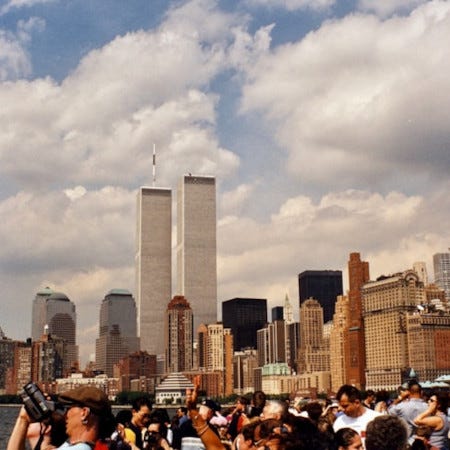
Photo by Tomas Martinez on Unsplash
That morning, I had some rare free time, so rose at my leisure and made it to the hotel’s restaurant for breakfast at around 9.00. There was something amiss in the room, I noticed. The tables were empty, and most guests were clustered around the bar, watching a ridiculous movie with far too loud special effects.
“What on earth is the matter with people?” I thought peevishly. “Have we all become so addicted to canned entertainment that we can’t be without it even during breakfast?”
Then there was a louder crash as American Airlines flight 175 plowed into the South Tower of the World Trade Center.
As soon as I decently could given the time difference, I called Mr. Los Angeles.
“Have you seen the news?” I asked him.
“I have some news for you,” he replied soberly. “Janine’s died.”
Janine was the lynchpin of a group of merry friends of ours who had met at Loyola Marymount University and remained as close as family ever since. A film production assistant, she had been driving to the set of her current movie in Bulgaria early that morning when, in a hauntingly apocalyptic twist, four wild horses (yes, really) had stampeded into her car, killing her instantly. Janine was brilliant-minded, golden-hearted, goofily funny, obsessed with Lord of the Rings, and counting the weeks until the opening of Peter Jackson’s movie trilogy later that year. She was 34 years old.
“I hate to think of you alone at home,” I told Mr. Los Angeles. “But I can’t come back right now.”
“Of course you can’t,” he said. “You’re working – see the week out.”
“You need to turn on the television,” I said.
There was a pause while he did so.
“Oh, my God,” was all I heard then.
There was no way any of us in Toronto could get home: with all airports closed, there was no way any of us could get anywhere. The management at our hotel, the Sutton Place on King Street West, could not have been kinder or more hospitable, inviting us to stay for as long as we need, helping us in any possible way they could: none of us will ever forget their generosity during our time of need. Nevertheless, we were stuck there, marooned in our own No Man’s Land, with nowhere to go – since, obviously, the Festival had shuttered immediately – and no clue as to what the future might hold, in America or anywhere.
For myself, I spent the time wandering the streets in the late summer sunshine, going nowhere, my mind a whirlpool. How could Janine be dead? How could the jihadists have done what they did? Oh, God, the people stuck in the Towers. Oh, God, their families. Would Los Angeles be next? Would I get home before something terrible happened there too? How would I get home anyway? Back up – could Janine really be dead?
Every so often, I would return to my hotel room to turn on the television in case there were news of the airports re-opening: every time I did so, I would see a repeat of what I had already seen on the Tuesday morning. Pretty soon, I stopped checking.
The silence in the sky above us was eerie. We take the sound of planes flying for granted, we complain about noise pollution, we rumble darkly about carbon footprints. It is only when there are no planes that we remember all the good parts of life they make possible. We start to ask ourselves – who is not going home today? Who is not able to take that joyfully planned, eagerly awaited international trip? Who will not receive their organ transplant? Who will not say good-bye to a loved one? When will I go home?
After a few days, a group of us rented a bus to drive us back into America, across the country and to LA. It was a coach bus with an odd layout, some seats facing forward, some facing each other, with little space and no hope of privacy. I did not like the look of it at all.
“I don’t think I can do this,” I said.
“Then don’t,” snapped Lawrie, the usually genial Australian who had emerged as our leader. “This is how it’s going to be, and if you can’t take it, don’t come.”
It was a deliberate tactic to force me to make up my mind – and it worked. I desperately wanted to be home.
And so we set off across the great North American continent, a motley group of ten or so journalists, an Australian, a German, a sweet-natured Swedish former hippie, two Japanese ladies, an Indian, a Portuguese, a lone American and a couple of Brits, all headed home to Los Angeles. Our legal statuses varied. Some of us held American passports; some had green cards but not yet the coveted citizenship papers; a couple held only the precarious protection of a foreign journalist’s visa, which allowed us to stay indefinitely on a “temporary” business trip, but forbade us to describe America officially as our home. I had recently acquired a green card myself; but as we approached the American border in this alien new post 9/11 world, I don’t think even the citizens felt entirely secure of what lay ahead.
Since we had left Toronto, we had been entertaining ourselves by cracking ever more silly jokes at which we laughed ever more hysterically. As we approached the border, Lawrie called us to order.
“Settle down,” he said. “No jokes, and no wisecracks. This is serious, and we need to get through it.”
As it was, the immigration officers were both warm and welcoming, and we passed through in the blink of an eye. I don’t think I’d ever hugged an immigration officer before, and I certainly haven’t hugged one since. This one was admittedly surprised; but he seemed quite pleased anyway.
Back at home, meanwhile, Mr. Los Angeles had been busy. The announcement had just gone out that the next day, the planes would be flying again: the scramble for tickets was ferocious, but Mr. Los Angeles is one determined man, and soon he had secured me a seat on the first plane out of Detroit. I knew nothing of this – extraordinary as it now may seem, I did not at the time possess a cell phone; extraordinary as it may now seem, this was not uncommon. The first I heard of it was when one of my more tech-savvy colleagues answered her own cell phone while we were bowling past the green fields of Michigan, and passed it over to me.
“Ask the bus driver where you are,” Mr. Los Angeles instructed me.
Obediently, I wove my way to the front of the bus.
“Where are we?” I asked.
“Beats me,” the driver replied. “I was just told to drive to Los Angeles.”
“Please talk to my husband,” I said, handing him the cell phone.
I am still unsure how Mr. Los Angeles elicited the information that we were approaching Flint, but not long after that, the bus dropped me and my baggage off at a dingy hotel somewhere on the outskirts of the city. We were still finding everything funny on the bus, and when we saw that the hotel was attached to a British pub that served fish and chips, this was the funniest of all: I left in a flurry of well wishes and pre-orders for the mixed seafood platter next time everyone was in town.
How the hotel staff privately reacted to the appearance of a hysterically giggling woman with a large suitcase and a British accent ordering a taxi to take her to the Marriott Hotel at Detroit Airport some 80 miles away, is unrecorded. But they were impeccably polite nevertheless, and the taxi arrived in record time.
I arrived at the Marriott late in the evening, exhausted, hungry, and wanting nothing so much as a shower, a meal, and bed.
“Name,” snarled the receptionist: she too was tired and hungry and made scant secret of the fact that she could hardly wait until the end of her shift.
I gave my name.
And that was when the already surreal occasion became more surreal still. Instantly, the receptionist’s face cleared, illuminated, became bathed in awe.
“It’s you,” she breathed.
She pressed a button under her desk, and four of her colleagues, similarly weary, similarly enraptured, ran to join her.
“It’s her,” she told them.
They exhaled a collective sigh of ecstasy.
“You,” the receptionist informed me, “have the cutest husband in the world.”
Now, for the record, I do kind of like Mr. Los Angeles. However …
“He wanted to send you flowers,” the receptionist announced incredulously. “Flowers!”
It appeared that Michiganders do not send flowers as freely as do Southern Californians.
“Well, that was nice,” I said, politely. “What room am I …”
“’Course, we don’t have any flowers in town,” said the receptionist. “No planes to deliver them. But get this.”
She leaned over her desk impressively.
“He’s sent you champagne instead,” she reported. She paused, for further effect. “And chocolates.”
Her four colleagues swayed in unison, a Rust Belt Greek chorus of appreciation.
“The cutest husband,” they agreed, “in the world.”
It seems that Michigan husbands are not ones for the romantic gesture. For the rest of my short stay at the hotel, I was treated by the entire female staff as a blend of Aphrodite, Helen of Troy, and Marilyn Monroe. Of all of the bizarre elements attached to that strange and dreamlike week, this – while undoubtedly agreeable – was possibly the most bizarre of all.
I arrived at Detroit Metropolitan Airport the next morning expecting I knew not what. As it turned out, the remarkable part about the flight home was the sheer ordinariness of it all. The same line as usual to check in, the same red and blue upholstered seats on the plane, the same recorded message of “Thank you for choosing to fly United,” for all the world as if America had not been irrevocably changed a few days earlier. We took off on time, flew without turbulence through the calm September skies, and landed on time in Los Angeles. And when the cutest husband in the world met me at the airport, we held each other as if we would never let each other go.
I’ll be thinking of Janine this September 11, as so many of our circle do every year. I’ll be thinking also of the people who died so terribly in the Twin Towers 25 years ago this year; I’ll be shedding a tear for their families, and raising a glass to all of the first responders who became heroes that warm September day.
Meanwhile, let’s all of us hold our loved ones close, today and every day.
799271 One of your very best, never once resorting to the mawkish or melodramatic
What a story. I've been reading so many 9/11 recollections over the past 48 hours, it's kind of hard not to.
Mr Los Angeles, wow, the dude's a legend!