


“Here lies poor Fred,
Who was alive and is dead.”
A cricket ball is a potentially lethal weapon. It has a core of cork covered with tightly wound string encased in a cover of leather the menacing color of oxblood and reinforced with a sturdy raised seam. It weighs a powerful five and a half to five and three-quarters ounces, and if it hits you in the wrong place, you can be seriously injured or even – as, reputedly, in the case of King George II’s son, Frederick, Prince of Wales (1707-1751), referenced in the satiric verse above – killed. You do not, to sum up, mess with a cricket ball
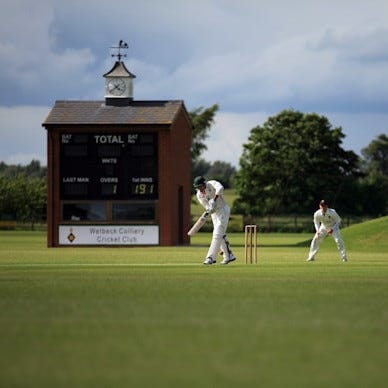
.Photo by Craig Hughes on Unsplash
And yet it is one of the many anomalies of English life that it is the particular timbre of the thwack that is produced by the densely packed leather of the cricket ball striking the lightweight willow wood of the cricket bat – the hymned “sound of leather on willow” – that evokes all that is gentlest and best of an English summer.
Cricket, like many of the finest of English traditions, is proudly ridiculous. Its rules, even by those who understand them, are all but impossible to explain; its matches can take up to five days to play and still sometimes end in a draw; it has fielding positions with names like Fine Leg and Silly Mid-Off; and should the famously parched English climate dare at any point to squeeze a drop of moisture from the heavens, there will be an amazed cry of “Rain stops play!” as batsmen, bowlers, and fielders will make their incredulous way to the pavilion to fortify themselves with beer and sandwiches while they consult the Duckworth-Lewis-Stern Method (yes, it is a thing) to calculate how many runs they would have scored had the weather co-operated. As earlier advertised in these pages, I personally loathe most sports; but I actually quite like cricket.
Cricket, in my preposterously male-heavy family, filled my childhood summer days as football my winter; but, oh, it was so much quieter than football and, oh, so blessedly less intense. Games would drift through the hours as the clouds drifted across the blue summer sky; there were long periods of reflection while new batsmen ambled from the pavilion to the pitch, wickets tumbled and were re-erected, and in the background hummed the sweet honeybee buzz of the famously long-winded cricket commentators passing the time of day by shooting breezes as gentle as the Zephyr. Years before The Hitchhiker’s Guide to the Galaxy, the young television writer Douglas Adams once entertained himself mightily by having Doctor Who’s Tardis land briefly in the middle of a cricket match, solely for the purpose of showing the two commentators discuss it with placid interest (“my word, this really is extraordinary”) and thoughtfully ponder the chances of an historical antecedent, before the machine took off again (“well, that wasn’t too bad, was it?”) into galaxies unknown. I have always considered that that short scene – barely two and a half minutes long, airily unencumbered by character development or plot, and jubilantly dotty – was in itself the very essence of the spirit of cricket.
The men in my family took the game greatly more seriously than did I. Endless hours from June to August were spent with the majority of the family barricaded in the living room, the curtains closed with Fort Knox-worthy precision against any chink of sunlight that might intrude to reflect off the television screen, as two-inch tall black and white figures with names like “Fiery” Fred Trueman and “Lord” Ted Dexter (who was posher than Fiery Fred, was married to a former model, and appeared with her in the television adverts for Noilly Prat, God, the glamour) bowled and batted and googlied and leg before wicketed while brothers and cousins and uncles would cheer and groan and curse and cheer again and outside the lovely sunshine slipped away to dusk.
It wouldn’t have been my own choice for spending a summer day; but then, it being summer and not winter, I had other opportunities available to me. I could go swimming with a friend; I could take my pocket money to Winchmore Hill, where there was a second-hand bookshop on the Green and an old-fashioned sweetshop on the way that sold delectables like humbugs and pear drops from glass jars and when they had less than a couple of ounces left in any one of the jars would tip the residue into a spare jar, which disgorged “penny bags” of thrilling unpredictability; or I could simply slide around the corner to the library, come back, and plump myself and my borrowed booty into the hammock under the apple tree, and read and read until my eyes dazzled and my mind distended to bursting point at the stories I was devouring in the dappled summer shade of the tree.
And that was another thing I liked about cricket: it meant it was summer, the brief but beautiful English summer, when the sun shone benignly and the birds sang early in the morning and the daylight stretched luxuriously late into the evening, when there were strawberries and cream for tea and ham and salad for supper, when I could at last liberate my itching legs from the terrible scratchy tights that had encased them all winter long, and at school we swapped our navy blue gym slips for cotton dresses the color of the sky that made the blue-eyed girls’ eyes even bluer, until we even stopped going to school at all and started on the six weeks of heaven that was the summer holiday.
But of all the good parts of cricket, the very best and most delightful of all, was that when my brothers weren’t watching it on the television, they were out at Lord’s or the Oval, watching it in person. And since cricket matches, unlike the niggardly ninety minutes long soccer matches, stretched the whole day through, it meant I had the house to myself for hour upon blissful hour. What was not to love?
As for the cricket ball that reputedly killed Frederick, Prince of Wales, back in 1751? Well, had Prince Frederick lived, it would have been he, not his son George, who would have inherited the throne of England when King George II died in 1760. And since Frederick apparently had a considerably greater interest in and skill for politics than did his science nerd, madness-approaching son King George III, it is not entirely impossible that when the American colonists started to act up in the 1770s, King Frederick might even have found a way to thwart the rebellion and keep America as part of the British Empire.
A rousing hip hip hoorah, then, and a hearty chorus of “Take Me Out To The Ball Game” for the sound of leather on willow.
I enjoy your writing so much!
I want.to understand cricket! Growing up in LA, I.enjoyed going to Dodger games with my Dad. He taught me how to lkeep a tally on a small piece.of paper of all the plays of the game. In LA it was quite unusual.to have a rain delay. I would say baseball is my favorite sport to watch
Nothing like a warm.summer evening,at the ballpark enjoying peanuts and beer.(Beer as an adult) Baseballs are also nasty flying objects. As the eldest daughter in the family of no boys my dad would take me out on.our lawn and pitch baseballs trying to teach me how to become an ace at bat.
I.took only one time for him.to.oitch the hard, hitting my thumb against the bat. OUCH...That ended my baseball career. It really stung and my nail turned black and blue and fell off. Quite traumatizing. You story brought up these lovely memories. I married Mr. Dodgers Baseball. Not an evening passes during the season that my husband isn't glued to the set for each Dodger game.